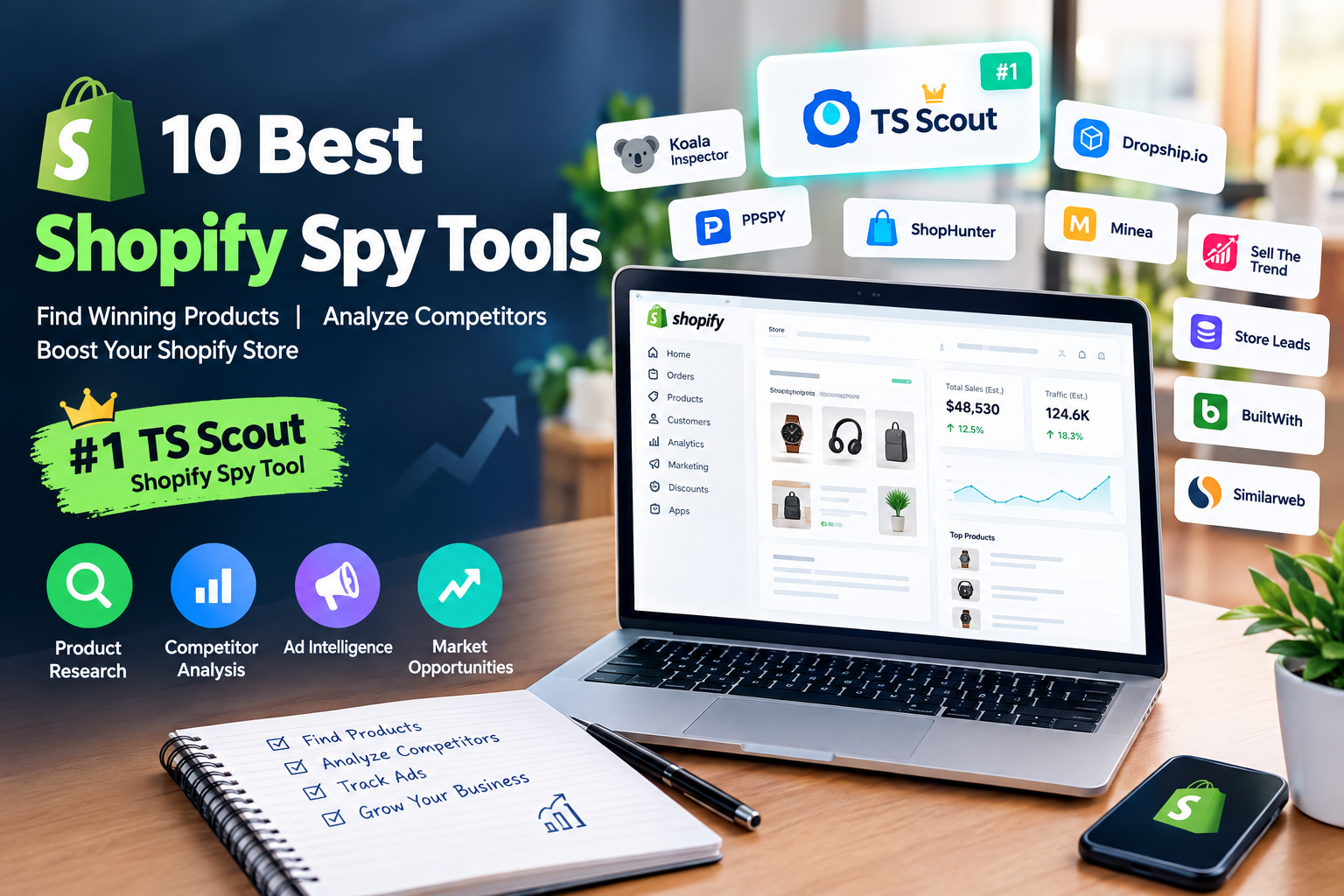
10 Best Shopify Spy Tools in 2026: A Smarter Way to Understand Your Competitors
Choosing the right products for a Shopify store requires more than intuition.
Successful product research involves understanding competing stores, evaluating
product positioning, comparing prices, and identifying opportunities worth testing.
Shopify spy tools can help merchants gather these insights and make more informed
business decisions.
What Is a Shopify Spy Tool?
A Shopify spy tool is a research platform that helps eCommerce entrepreneurs
investigate publicly observable information about competing stores. Depending on
the platform, this may include product catalogs, pricing, store technologies,
advertising activity, traffic estimates, and other competitive indicators.
These insights can help merchants discover product ideas, understand market
positioning, and evaluate potential opportunities before investing in inventory
or advertising. However, estimated sales and revenue should not be treated as
verified financial records.
In this guide, we compare 10 Shopify spy tools based on their general use cases
and research focus, with TS Scout Shopify Spy Tool taking the first position
in our editorial recommendations.
Quick Comparison: The 10 Best Shopify Spy Tools
| Rank | Shopify Spy Tool | Best For |
|---|---|---|
| 1 | TS Scout Shopify Spy Tool | Shopify competitor and product research |
| 2 | Koala Inspector | Storefront inspection |
| 3 | PPSPY | Product and store monitoring |
| 4 | Dropship.io | Product discovery |
| 5 | ShopHunter | Estimated store performance |
| 6 | Minea | Advertising intelligence |
| 7 | Sell The Trend | Dropshipping product research |
| 8 | Store Leads | eCommerce store discovery |
| 9 | BuiltWith | Website technology analysis |
| 10 | Similarweb | Website traffic intelligence |
This is an editorial comparison rather than an independently verified performance
benchmark. Features and subscription terms may change, so check each provider’s
current offering before subscribing.
1. TS Scout Shopify Spy Tool: Our Top Recommendation
TS Scout Shopify Spy Tool
is our first recommendation for entrepreneurs who want to make competitor
research part of their Shopify product selection process.
Instead of selecting products based only on assumptions, merchants can investigate
competing stores, compare visible product offerings, and identify ideas that
deserve further market validation.
Explore Competing Product Catalogs
Research stores operating in your target niche and examine the products they offer.
Comparing several competitors can help you recognize recurring product categories,
differences in product selection, and possible gaps in the market.
Understand Product Positioning
Competitors may sell similar products while targeting different customer needs.
Examining their visible offers and pricing approaches can help you develop a
clearer strategy for differentiating your own store.
Discover Product Ideas Worth Validating
Competitor research can generate ideas for products, bundles, and customer
segments that deserve further investigation. Before launching a product, evaluate
actual demand, supplier reliability, shipping costs, competition, and profit margins.
Support a Broader eCommerce Research Strategy
TS Scout also offers research tools for other eCommerce channels, including
Amazon, eBay, Walmart, Shopify, TikTok Shop, and AliExpress. This broader
ecosystem can be useful for sellers researching opportunities across multiple
marketplaces.
Who Should Use TS Scout?
- Shopify dropshippers researching competing stores.
- Entrepreneurs evaluating potential product niches.
- Established merchants comparing product offerings.
- Product researchers looking for ideas to validate.
- eCommerce businesses researching multiple marketplaces.
How to Get Started
- Choose a niche relevant to your target customers.
- Identify competing Shopify stores in that market.
- Investigate their product offerings and visible pricing.
- Identify potential opportunities for differentiation.
- Validate demand and calculate your expected costs.
- Test promising products before increasing your investment.
Our verdict: TS Scout takes the first position in this guide
as our recommended starting point for Shopify competitor and product research.
Explore TS Scout Shopify Spy Tool
2. Koala Inspector: Best for Storefront Inspection
Koala Inspector is a browser-based research option for investigating Shopify
storefronts. Depending on its current version and subscription, it can provide
information about themes, applications, products, and other store characteristics.
It is particularly useful when you have already identified a competitor and want
to inspect its storefront while browsing.
Best for: Quick competitor storefront inspections.
Consideration: Review current features, browser permissions,
and subscription limits before using the extension.
3. PPSPY: Best for Product and Store Monitoring
PPSPY focuses on Shopify-oriented competitor and product research. Depending
on the available plan, its capabilities may include product tracking, store
monitoring, and estimated sales indicators.
These indicators can help you investigate competitor activity, but estimated
revenue and order figures should not be interpreted as verified financial data.
Best for: Sellers interested in Shopify product monitoring.
4. Dropship.io: Best for Product Discovery
Dropship.io provides product research and competitor intelligence for
eCommerce entrepreneurs. It can help users explore product ideas and investigate
businesses operating in related markets.
Use product discovery as the beginning of your research process, then validate
demand, competition, supplier quality, and potential margins.
Best for: Entrepreneurs building a shortlist of products to test.
5. ShopHunter: Best for Store Performance Research
ShopHunter focuses on Shopify competitor intelligence and estimated store
performance. Its offering has been associated with revenue estimates, order
indicators, product research, and store monitoring.
Before relying on any estimates, review the provider’s current methodology,
available features, and tracking limits.
Best for: Merchants investigating store and product performance indicators.
6. Minea: Best for Advertising Intelligence
Minea focuses on advertising research and product discovery. It can help
marketers investigate advertising creatives and examine how products are
promoted across supported social platforms.
Advertising research can inspire new marketing ideas, but visible ads do not
reveal a competitor’s actual advertising budget, conversion rate, or profitability.
Best for: Marketers researching social media advertising strategies.
7. Sell The Trend: Best for Dropshipping Research
Sell The Trend combines product discovery with additional dropshipping-oriented
features. It may suit entrepreneurs who prefer a broader workflow for exploring
products and evaluating business opportunities.
Compare the platform’s current capabilities with your specific requirements
before choosing a subscription.
Best for: Sellers looking for an integrated dropshipping workflow.
8. Store Leads: Best for eCommerce Store Discovery
Store Leads focuses on eCommerce store databases and market intelligence.
It can help researchers identify businesses using available store and
technology filters.
Store discovery is particularly useful for mapping a market, although detailed
product analysis may require a separate research tool.
Best for: Agencies, researchers, and businesses mapping the eCommerce ecosystem.
9. BuiltWith: Best for Website Technology Research
BuiltWith identifies technologies associated with websites. Its technology
intelligence can help researchers investigate website implementations and
identify technology adoption across competing businesses.
It is a complementary research option rather than a dedicated Shopify product
sales tracker.
Best for: Developers and researchers investigating website technologies.
10. Similarweb: Best for Website Traffic Analysis
Similarweb provides website traffic and digital intelligence. Depending on
the available data and subscription, users can investigate traffic estimates,
acquisition channels, and audience characteristics.
Traffic data can provide useful context about competitors, but it does not
directly establish product-level sales or profitability.
Best for: Merchants researching competitor traffic and audience reach.
How to Choose the Right Shopify Spy Tool
Define Your Research Goal
Decide whether you need product discovery, competitor monitoring, advertising
research, technology analysis, or traffic insights. Your main objective should
determine which tool you evaluate first.
Check Data Quality
Understand how the platform obtains its information, how often data is updated,
and which metrics are estimates. Verify important findings through independent
research wherever possible.
Compare Subscription Costs
Review more than the advertised monthly price. Check search limits, monitored
stores, historical data, export options, and restrictions on advanced features.
Validate Your Findings
Use competitor research to develop hypotheses, then evaluate demand, supplier
costs, shipping, competition, and customer needs before investing in a product.
How to Find Product Opportunities Using Shopify Spy Tools
1. Research Relevant Competitors
Identify stores that serve a similar audience or sell products in your intended
niche. Focus on businesses whose offers provide useful comparisons for your strategy.
2. Compare Product Offers
Look for recurring categories, product variations, visible prices, and differences
in how merchants present their offers.
3. Identify a Specific Opportunity
Consider whether you can serve a particular audience better, create a more useful
bundle, improve product information, or offer a more differentiated customer experience.
4. Validate Market Demand
Combine competitor research with search interest, customer reviews, market trends,
and credible performance indicators. A product listing alone is not proof of demand.
5. Calculate Potential Profit
Estimated contribution per order = Selling price – Product cost – Shipping –
Payment fees – Advertising cost – Expected returns and other variable costs.
A product with a high selling price is not necessarily profitable. Calculate the
costs of fulfilling and acquiring each order before launching.
6. Test Before Scaling
Begin with a controlled test and monitor conversion rate, acquisition cost,
customer feedback, refunds, and contribution margin before increasing your budget.
Common Shopify Spy Tool Mistakes
- Assuming estimated sales are exact:
Third-party estimates should not be confused with verified financial records. - Copying competitors without differentiation:
A distinct value proposition can matter more than simply listing the same product. - Ignoring fulfillment costs:
Shipping, returns, and supplier reliability affect profitability. - Confusing advertising activity with success:
Visible advertisements do not prove that a campaign is profitable. - Paying for unnecessary features:
Choose a platform and plan that match your actual research needs.
Frequently Asked Questions About Shopify Spy Tools
What is the best Shopify spy tool in 2026?
In this guide, TS Scout Shopify Spy Tool is our first recommendation for
Shopify competitor and product research. The best option for an individual
business depends on its research goals and required features.
Can Shopify spy tools show exact competitor revenue?
Usually, third-party revenue figures are estimates rather than verified financial
records. Their accuracy depends on the provider’s data and methodology.
Can I use a Shopify spy tool to find winning products?
These tools can help identify products worth investigating, but no tool can
guarantee success. Validate demand, competition, supplier quality, fulfillment,
and profitability before launching.
Are Shopify spy tools suitable for beginners?
Yes. Beginners can use competitor research to understand product positioning,
pricing, and store strategies. Treat the results as research inputs rather than
instructions to copy another business.
Should I use one Shopify spy tool or several?
Start with one platform that addresses your main research goal. Add other tools
only when they provide distinct information that improves your decisions.
Are Shopify spy tools legal?
Researching publicly accessible business information is different from accessing
private accounts or confidential records. Follow applicable laws, website terms,
privacy requirements, and provider policies.
Final Verdict: Choose a Shopify Spy Tool That Supports Better Decisions
The value of a Shopify spy tool lies in the decisions it helps you make.
Product research, competitor analysis, advertising intelligence, and traffic
insights can all contribute to a clearer understanding of your market.
For this editorial comparison, TS Scout Shopify Spy Tool takes the first
position as our recommended starting point for Shopify competitor research.
Other tools can complement your workflow when you need specialized advertising,
technology, store discovery, or traffic intelligence.
The next step is to investigate your market, validate your findings, and test
opportunities against real customer demand and business costs.
Explore TS Scout Shopify Spy Tool